Reports of a contract extension for Tengku Muhammad Taufik as Petronas president and group chief executive have triggered fresh scrutiny as the national oil company confronts defeat in the Kingtime patent dispute, potentially substantial damages, declining profits and an unresolved standoff with Sarawak.
KUALA LUMPUR: The government should reconsider any decision to retain Tengku Muhammad Taufik Tengku Aziz as president and group chief executive officer of Petroliam Nasional Bhd (Petronas), rather than grant him a second extension while major controversies surrounding his leadership remain publicly unresolved.
The Edge reportedly said Tengku Taufik had received a second extension as Petronas president, group CEO and executive director following the expiry of his tenure in July. The new term could reportedly run for at least another two years.
Petronas, however, has reportedly declined to comment. Official details concerning the length and terms of the extension—and the performance assessment used to justify it—have therefore not been publicly disclosed.
If the reported extension is confirmed, the government must explain whether it conducted a comprehensive review of Tengku Taufik’s management record, particularly Petronas Carigali Sdn Bhd’s handling of its prolonged and costly patent dispute with Kingtime International Ltd involving Petrofac.
Petronas Loses Kingtime Patent Battle
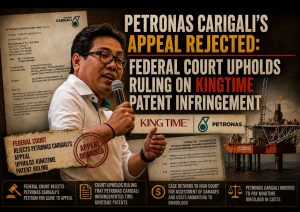
On May 4, 2026, the Federal Court dismissed Petronas Carigali’s application for leave to appeal against the Court of Appeal’s ruling in favour of Kingtime.
The Court of Appeal ruled in November 2025 that Kingtime’s patent was valid and had been infringed by Petronas Carigali. It remitted the case to the High Court for an assessment of damages.
The dispute concerns the use of Kingtime’s patented detachable wellhead structure on a mobile offshore production unit, or MOPU, deployed at the Sepat oilfield.
Petrofac E&C Sdn Bhd—a subsidiary of Britain-based Petrofac and the contractor responsible for designing and constructing the MOPU—had previously been found to have infringed Kingtime’s patent. The ruling against Petrofac became final after its appeal process ended in 2020.
The central question is why Petronas Carigali continued fighting the case for years when Petrofac’s infringement had already been determined in earlier proceedings.
Who authorised the litigation strategy? What commercial assessment supported it? And how much has Petronas spent pursuing a case that ultimately ended with the dispute being returned to the High Court for damages to be assessed?
What Happened to Petrofac’s Indemnity Protection?
The controversy deepened after a June 2026 report by The Edge raised the existence of an indemnity provision in the contract between Petronas Carigali and Petrofac.
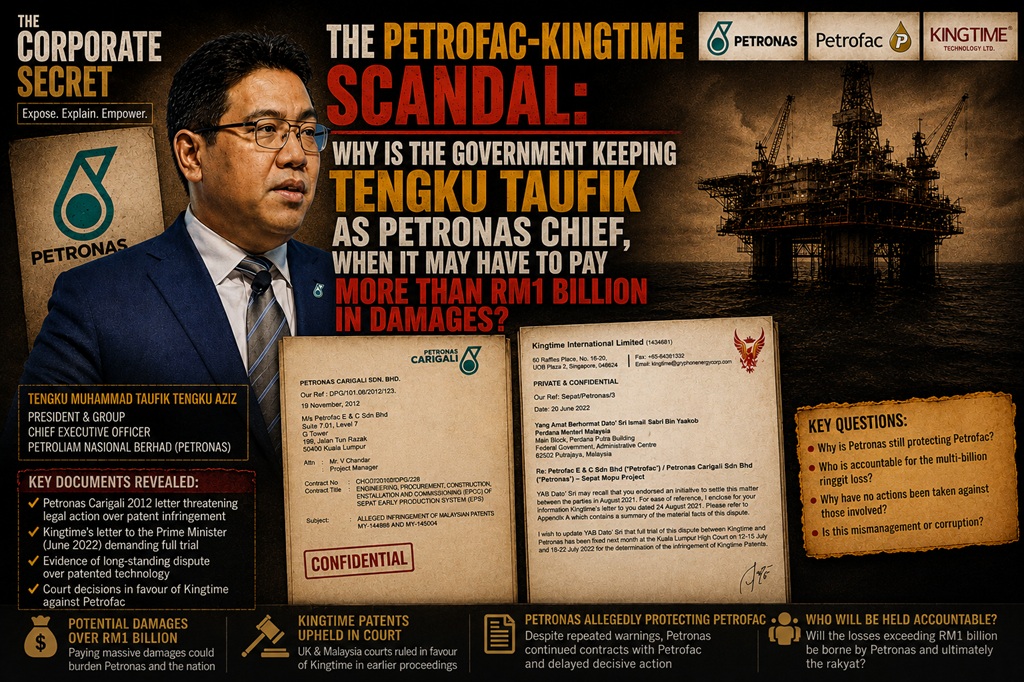
A Petronas Carigali letter to Petrofac dated November 19, 2012, reportedly stated that the company was invoking its indemnity rights under Article 39 of the engineering, procurement, construction, installation and commissioning contract.
The provision essentially required Petrofac to indemnify Petronas Carigali against losses, claims, costs and expenses resulting from patent infringement connected with the performance of the contract.
What happened after the letter was issued remains unclear. Petronas has also reportedly yet to explain whether it pursued or enforced the indemnity, and why that contractual protection does not appear to have eliminated its financial exposure.
The figure exceeding RM1 billion associated with the case has not been fixed by the court as final damages. It reportedly represents an estimate of the potential claim or financial exposure based on Kingtime’s documents and calculations.
Nevertheless, the ruling in Kingtime’s favour and the continuing assessment of damages make the risk real. Petronas management owes the public a full account of how the dispute was handled and what financial consequences the company may now face.
Questions Over Alleged PM9 Instructions
The Corporate Secret previously disclosed two letters from Kingtime to Malaysia’s ninth prime minister, Datuk Seri Ismail Sabri Yaakob, dated August 24, 2021, and June 20, 2022.
According to the documents, handwritten minutes purportedly directed the Petronas president and group CEO to resolve the matter.

Kingtime had also reportedly offered a global settlement without any admission of liability. Despite that offer, the litigation continued all the way to the Federal Court.
The documents raise several critical questions. What action did Tengku Taufik take after the matter was referred to him? Was Kingtime’s proposed settlement independently and properly assessed? Who decided to continue the litigation, and what was the commercial justification for doing so?
The existence of the letters does not, by itself, conclusively prove that Tengku Taufik deliberately defied an instruction or protected Petrofac. Such serious allegations require documentary proof and a response from Petronas. Nevertheless, the apparent failure to resolve the dispute—and the decision to continue litigating despite the potential exposure—demands an independent explanation.
Petronas must disclose whether the Prime Minister’s Office issued a formal directive, how the company responded and whether the board approved the decision to continue the case.
Profits Decline as Thousands of Jobs Are Cut
The reported extension also comes as Petronas faces substantial pressure on its financial performance.
Petronas recorded profit after tax of RM45.4 billion for 2025, down from RM55.1 billion in 2024. Revenue declined from RM320 billion to RM266.1 billion.
This marked the third consecutive year of lower profits, although oil prices and broader global industry conditions also affected the company’s performance.
At the same time, Petronas embarked on a restructuring exercise involving a reduction of approximately 5,000 positions.

When thousands of employees are made to bear the consequences of corporate restructuring, the government has an even greater responsibility to disclose the performance criteria used to extend the tenure of the company’s highest-ranking executive.
Employees should not be the only ones held accountable for deteriorating financial conditions. Senior management’s decisions—including litigation strategy, risk management and the handling of major commercial disputes—must be subjected to equally rigorous scrutiny.
Sarawak Dispute Remains Unresolved
Petronas also remains embroiled in a prolonged dispute with Sarawak over regulatory authority, gas aggregation and control of the state’s petroleum resources.
Sarawak occupies a strategically important position in Malaysia’s gas supply chain and hosts Petronas’ principal liquefied natural gas complex.
A failure to reach a clear and durable settlement carries consequences beyond the courtroom. It could affect national energy security, Petronas’ revenue and relations between the federal and Sarawak governments.

Against this backdrop, any extension of Tengku Taufik’s contract should be justified by a demonstrable record of resolving major disputes, managing risk and protecting Malaysia’s strategic interests—not merely by appeals for continuity at the top.
Government Must Disclose the Basis for Reappointment
Petronas is not an ordinary private corporation. Under the Petroleum Development Act 1974, the national oil company is vested with petroleum rights and is subject to the direction and control of the prime minister.
The government therefore cannot treat the appointment of Petronas’ president and group CEO as a purely internal corporate matter exempt from public accountability.
Before Tengku Taufik is granted a renewed mandate, the government and Petronas should disclose:
- the performance assessment used to justify his extension;
- the relevant decisions of the Petronas board and nomination committee;
- the company’s actual potential liability in the Kingtime case;
- the action taken to enforce Petrofac’s indemnity obligations;
- the response to the letters reportedly referred by the ninth prime minister;
- the total legal costs incurred throughout the litigation; and
- Petronas’ strategy for resolving its dispute with Sarawak.
Without such disclosures, Tengku Taufik’s extension will inevitably be viewed as a decision that disregards unresolved questions of governance, accountability and financial stewardship.
It has also been claimed that any settlement or payment exceeding RM1 billion would require approval at the highest levels of government, including the prime minister and finance minister. That assertion must be independently verified against Petronas’ governance and approval framework.
If senior government officials have already been briefed on Petronas’ potential exposure, they must explain what they knew, when they knew it and why Tengku Taufik’s contract was nevertheless extended before the Kingtime matter was fully resolved.
A potential RM1 billion loss cannot be dismissed as a routine legal expense. It would represent a major financial blow to a company responsible for managing one of Malaysia’s most important strategic assets.
The government should suspend or reconsider Tengku Taufik’s reported reappointment until an independent audit is conducted and all questions surrounding the Kingtime–Petrofac dispute are answered openly.
Leadership continuity cannot become a shield against accountability. Nor should it be used to conceal questionable decisions involving the management of Malaysia’s national petroleum wealth.