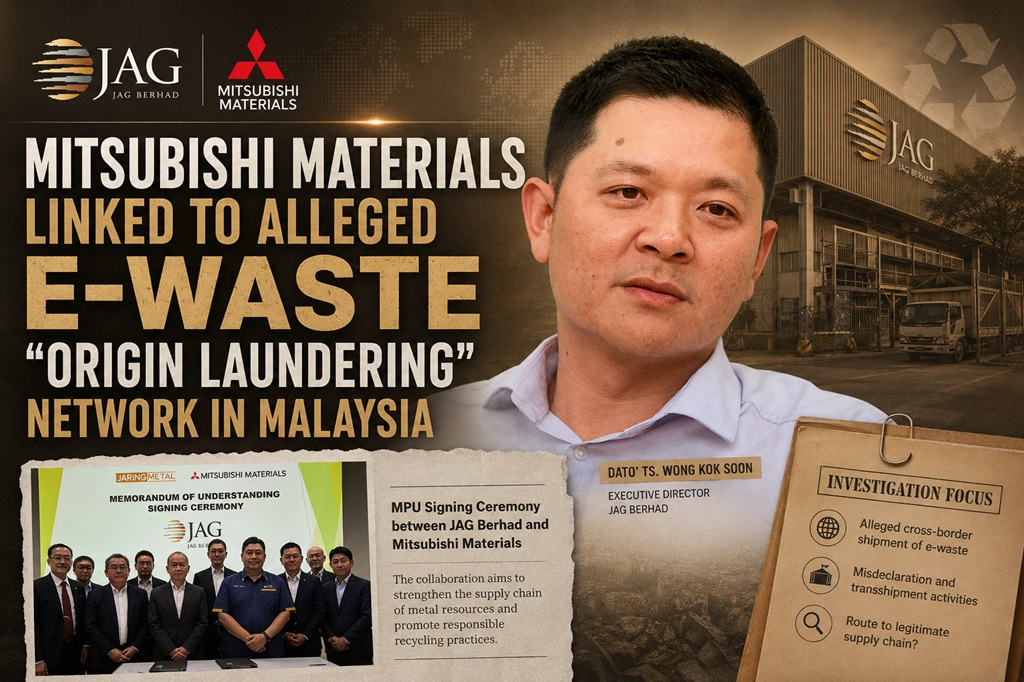
KUALA LUMPUR – A serious reputational and regulatory storm may be brewing for Mitsubishi Materials Corporation (MMC), following allegations that its corporate partnership in Malaysia could be indirectly linked to a sophisticated illegal e-waste syndicate.
At the centre of the controversy is Jaring Metal Industries (JMI), a subsidiary of JAG Berhad, which is accused of acting as a conduit for systematic “origin laundering” of illicit electronic waste operations.

Caption: Official signing ceremony between Mitsubishi Materials and JAG Berhad, establishing formal collaboration with Jaring Metal Industries.
Shadow Network: From Corporate Partnerships to Illicit Flows
What initially appears to be a legitimate recycling collaboration is now being scrutinised under a far more serious lens. Documents and disclosures indicate that enforcement agencies are facing significant challenges in identifying the ultimate beneficiaries behind illegal e-waste operations.
These activities are allegedly conducted through shell companies and proxy entities, which handle the importation and initial processing of illegal e-waste before routing materials through licensed firms such as JMI for export.
The mechanism allows hazardous waste to be partially processed locally, with high-value components exported abroad under fraudulent or manipulated declarations, effectively bypassing international compliance frameworks.

Caption: Mitsubishi Materials’ internal strategy slide confirming collaboration with Jaring Metal Industries in Malaysia under its ASEAN recycling expansion plan.
Who Are the Directors and Major Shareholders of JAG Berhad?
JAG Berhad is principally controlled by a closely linked group of executive directors and major shareholders led by the Ng family, who maintain significant influence over the company’s e-waste recycling and metal recovery operations in Malaysia. Among the key figures is Dato’ Ng Meow Giak , the company’s Executive Director and one of its substantial shareholders, widely regarded as a central figure in JAG’s industrial recycling business. The board is also chaired by Datin Stacey Tan Siew Ching, who holds a notable equity interest in the company, alongside other directors involved in governance and operational oversight.


The company’s shareholding structure reflects strong concentration among insiders and related parties. Dato’ Ng Aik Kee is understood to be among the largest shareholders in JAG Berhad, while Ng Yaw Long and NKK Capital Sdn Bhd also maintain sizeable holdings that reinforce the broader family-linked control over the listed entity. This concentration of ownership has drawn attention due to JAG’s expanding role in the regional e-waste and metal recycling supply chain, including collaborations involving Mitsubishi Materials through operational arrangements linked to Jaring Metal Industries (JMI).
“Origin Laundering”: Leveraging Global Reputation
More critically, insiders allege that JMI is leveraging its association with Mitsubishi Materials Corporation to mask illicit activities under a legitimate global corporate framework.
This strategy, described as “origin laundering”, involves:
- Embedding illegal supply chains within licensed operations
- Using multinational partnerships to enhance credibility
- Facilitating cross-border exports under the guise of compliant recycling
Concerns have also been raised regarding financial disclosures, particularly unusually high inventory levels that may not correspond with actual physical stock.

Caption: National police leadership acknowledges the possibility of e-waste syndicates operating with connections among industry players.
Regulatory Gaps and Syndicate Involvement
The issue is no longer theoretical. Statements by Malaysia’s top law enforcement officials indicate that illegal e-waste processing may be linked to organised syndicates embedded within industry networks.
As highlighted in media reports, authorities have not ruled out the involvement of industry players themselves in facilitating these operations, reinforcing concerns of systemic collusion.
At the same time, enforcement efforts such as Ops Hazard 3.0 have resulted in hundreds of arrests and significant seizures, underscoring the scale of the problem.

Caption: Minimum purity thresholds required under Malaysian regulations for export of recovered metals, highlighting strict compliance requirements.
Compliance Breakdown: Purity Standards and Technical Failures
Under Malaysian environmental regulations, full recovery facilities are strictly prohibited from exporting processed materials unless they meet purity thresholds exceeding 99% for precious metals.
However, industry estimates suggest that up to 95% of licensed operators fail to meet these technical standards, engaging only in basic dismantling or stripping processes.
This creates a loophole where:
- Illegal operators conduct actual recovery
- Licensed firms act as export fronts
- Hazardous waste remains in Malaysia
- High-value materials are exported under compliant labels
Financial Manipulation and Laundering Concerns
The controversy extends beyond environmental violations into potential financial misconduct.
JAG Berhad is alleged to have:
- Entered multiple Memoranda of Understanding (MOUs) that failed to materialise
- Used such announcements to influence market perception
- Channelled illicit proceeds into property and cash-based businesses
Funds linked to these activities are estimated to involve hundreds of millions of USD, potentially laundered through layered investments and commercial fronts.
Echoes of Past Corporate Scandals
Observers have drawn parallels with the collapse of Citiraya Industries, a high-profile case involving fraudulent recycling operations and governance failures.
The similarities—including misuse of licenses, export manipulation, and cross-border laundering—suggest that history may be repeating itself under a more complex corporate structure.
Urgent Calls for Action
Given the severity of the allegations, stakeholders are urging immediate intervention:
- Immediate Suspension of all transactions involving JAG Berhad
- Independent Forensic Audit of inventory and financial records
- Governance Review to identify conflicts of interest
- Nationwide Enforcement Operations involving technical agencies
High Stakes for Global Reputation
Failure to act decisively could expose Mitsubishi Materials Corporation to significant:
- Regulatory scrutiny
- Cross-border legal risk
- Reputational damage in ESG and global compliance frameworks
In an era where supply chain transparency is paramount, any perceived complicity—even indirect—may carry lasting consequences.
Bottom Line
What appears to be a legitimate recycling partnership may, if substantiated, represent a deeply embedded network of environmental violations, financial manipulation, and international trade abuse—placing both Malaysian operators and global partners under intense scrutiny.
Related Article